Critical Points
Wagon with payload or vehicle cross-sectional features that are likely to be of significance to gauge check shall be identified as critical points. Critical points are to be declared only where the loading gauges are fouled.
If the payload has a complicated shape, a sketch of the consignment in the three views should be attached, showing all the critical points for the consignment and the position of the centre of gravity (COG Centre of Gravity).
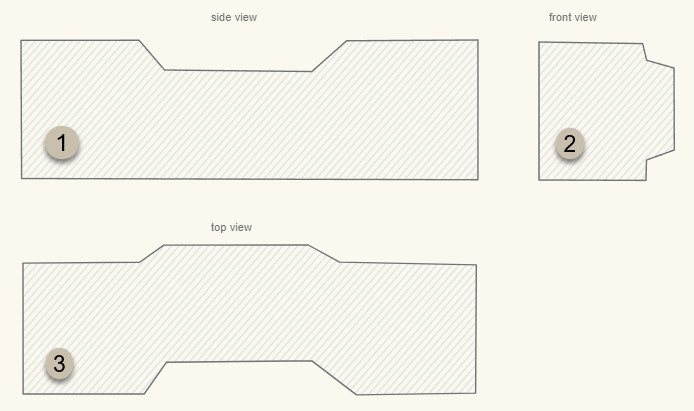
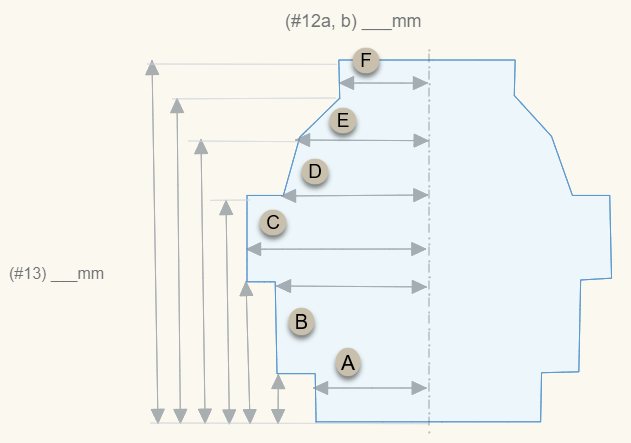
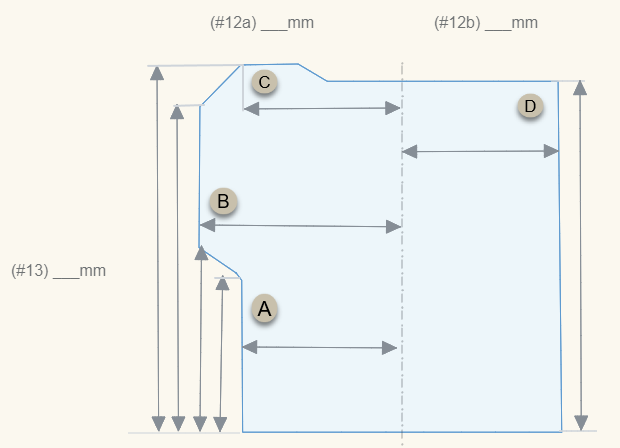
On the sketch, the critical points exceeding the international loading gauge that were measured without tolerance on the load shall be indicated by capital letters A, B, C. Allocation of letters starts at the lower left and continues in a clockwise direction.
The coordinates of the critical points of the load are determined by taking measurements on both sides of the wagon while the wagon is stationary on straight and level track.
The basic parameters of cube-shaped consignments include:
- Height - vertically from the top surface of the rail head, separately for each inflection point of the load contour.
- Width - horizontally from the longitudinal axis of the wagon to the edge of the load at each inflection point of its contour
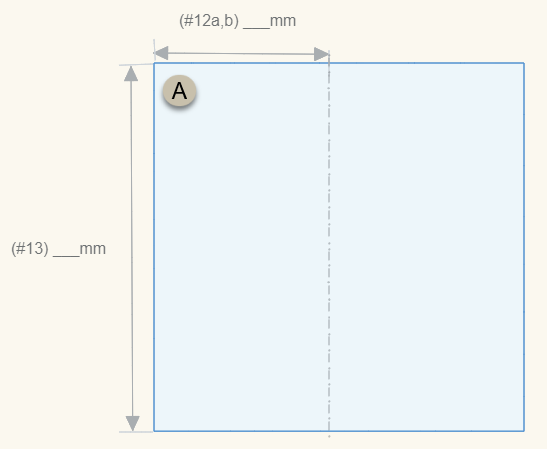
For more complex contours:
- When symmetrical, the contour points may be assigned on one half-width and mirrored to the other. Critical point letters are assigned left from the bottom to the top of the consignment, and mirrored on the right side of the drawing.
- When non-symmetrical, the contour points are assigned separately for the left and the right side of the contour. Critical point letters are assigned from the bottom left half of the consignment to the top and clockwise the from the top to the bottom of the right half.
In addition to height and width, the longitudinal dimension of the loads may also affect the gauge fouling; basically the longer the wagon, the narrower the wagon width within the same loading gauge contour.
When describing the critical points relative to the longitudinal axis of the wagon, use the terms and symbols in the table below as appropriate.
| Points in longitudinal location |
Symbol in gauge calculations
/ Application Code |
Location | Wagons without bogies | Wagons on bogies | The lifting swivel benches of a pair of wagons |
|---|---|---|---|---|---|
|
Internal point |
ni / #14 |
Between |
The outer (outermost) axles |
The axles of the bogies pivots |
The pivots of the wagon bridge, or between the pivots of the lifting swivel benches of a pair of wagons |
|
The midpoint |
ni max / #14 |
Half-way between |
The outer (outermost) axles |
The axles of the bogie pivots |
The pivots of the wagon bridge, or between the pivots of the lifting swivel benches of a pair of wagons |
|
Outer point |
na / #15 |
Beyond |
The outer axles |
The axles of the bogie pivots |
The pivots of the wagon bridge, or between the pivots of the lifting swivel benches of a pair of wagons |
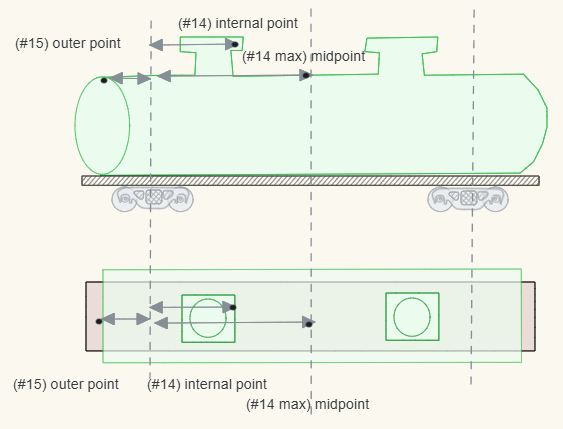
Information: Bear in mind that an off-centre position of the centre of gravity of the load may require the load to be shifted from its longitudinally symmetrical position on the wagon towards one side of the wagon in order to maintain the maximum allowed load on all the wheel sets of the wagon. In such a case, the determination of the critical points should be carried out for the target position of the load on the wagon.
Note: Critical Dimensions. After adding the values of the operating deviations and the allowance for curves or other components of the loading gauge calculations, the critical points become the critical dimensions of the consignment.