Loading Gauge
UIC Loading Guidelines Volume 1 contain eighteen tables with parameters of the loading gauges. These loading gauge profiles describe contours of static gauges permissible on specific infrastructure managers' networks. There you will also find a list of around forty entities and the loading gauges that they apply.
Loading gauge is a concept of predefined dimensions of height and width of a wagon with cargo. It is defined by the dimensions of height and width above the rail top, dimensions that must not be exceeded by a rail vehicle or its load so as not to foul the line’s side fixtures or structure.
The size of the permissible area encompassed by the loading gauge contour depends on the gauge calculation method. For exceptional transports, static gauge calculation is easiest to carry out, and therefore, while filling out the application you declare the parameters necessary for this type of calculation.
Information on loading gauges and:
• Their static contours for most European countries you find in the UIC Loading Guidelines Volume 1.
• The access conditions referring to Exceptional Transports may be stated in IMs' Network Statements or their internal instructions.
Information: When you are responsible for transport through a number of IM networks you may need to check information on each network individually. In such a case the smallest loading gauge applies for the entire route.
The following table describes the best known static gauges in continental Europe.
|
Symbol |
Loading gauge description |
|---|---|
|
G1 |
International loading gauge. This is the smallest of the available gauges with maximum height 4.28 m. This gauge is the oldest, and it is used for routes with strict restrictions. This gauge is considered interoperable except for Great Britain. |
|
GA |
Often referred to as the "general gauge", it is used for international traffic in Europe. Maximum height 4.32 m. |
|
GB |
This gauge allows for larger dimensions than GA, and is used for a limited number of routes. Maximum height 4.32 m. |
|
G2 |
This is larger than GB and is used for specific routes that can accommodate such dimensions. Maximum height 4.65 m. Some of IMs accept this gauge, but not all. |
|
GC |
This is larger than G2 and is the largest of all loading gauges. Currently it is used for specific routes that can accommodate such dimensions. In railway documentation this gauge is referred to as the target gauge. Maximum(static) height 4.65 m. |
The only difference between the GA, GB, and two additional GB1 and GB2 gauge profiles is the degree of bevelling.
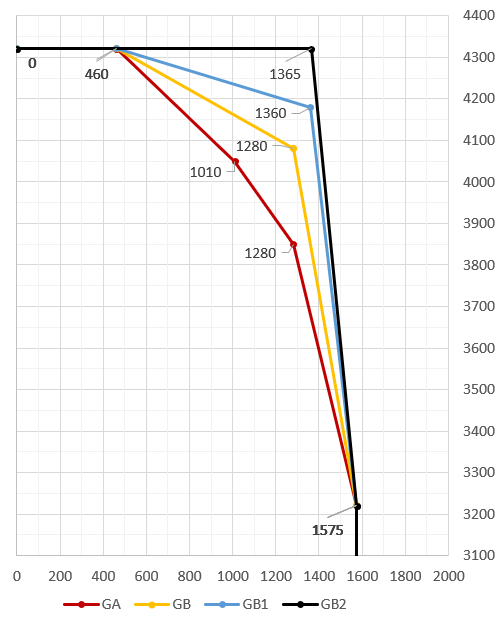
Specific rules on the loading gauge check and the gauge restrictions necessary for filling in the application purpose are laid out in the UIC Loading Guidelines. In addition, observe national IM’s rules.
Note: Some IMs have defined on their networks kinematic loading gauge profiles for combined transport, as for the specifically defined loads, in line with the provisions of UIC Leaflet 506.
Caution: Countries like France, Norway and Italy use smaller gauges, and therefore when working on applications to these countries, remember to verify the smallest gauge en-route. For other countries and loading gauge profiles always consult UIC Loading Guidelines when in doubt.